
Family Xchange Games
Real board, real pieces, everybody round the table. The app deals the cards, keeps the rules and knows how old each player is — then gets out of the way. One screen for the whole room instead of one each, and the children end up looking at each other.
The screen question, answered first
Every parent reading this has the same suspicion, and it is a fair one: an app in a board game usually means a child staring at a phone while everybody else waits.
This is built the other way round. One device serves the whole room — it sits in the middle, face up, like a referee. There is no feed, no scrolling, no score to chase on glass and nothing to unlock. Its entire job is to know whose turn it is, deal a card suited to that player's age, play the character who asks it, and go quiet again. The game happens between the people.
What the technology buys you is the part a printed deck cannot do: a five-year-old and a fifteen-year-old land on the same square and get completely different questions, the deck keeps growing so it takes a long while to repeat, and the things you would rather your children heard from you arrive in the right order, at the right age, with everybody laughing a moment before and a moment after.
If you have a television in the room, that is the cleanest version of it: the board goes up on the big screen where everybody can see it, and the only thing anyone holds is their own turn.
How it plays
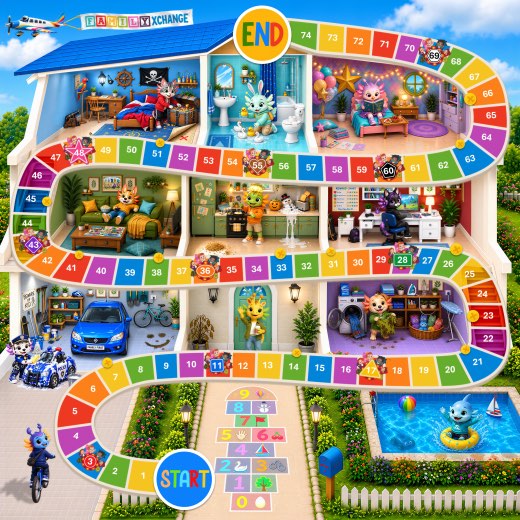
Each board is a winding path of 74 illustrated tiles from START to END. Most are ordinary squares. The rest are where the app takes over.
A die, a token and a path — the bit every child already understands. Nothing about the first thirty seconds needs explaining to anybody.
The app deals a card pitched at that player's age and one of the characters asks it: act it out, name three, tell us about the time, or say what you actually think.
Manage it and you move forward; don't and you hold your ground or slip back a little. Gold coin squares fire a power play — jump ahead, swap places, gift a move, raise a shield. First to the end wins, or beat the clock together.
What is on the cards
Every card belongs to one of three tiers. The first two are always on. The third is entirely parent-controlled, per topic and per child — and children never see the settings menu.
Tier 1 · Always on
Favourites, family memories, silly dares, and the questions that end with everybody laughing at the same thing. This is the floor of every session, and the reason a seven-year-old asks to play again.
Tier 2 · Always on
Chores, kindness, money basics, manners and safety — the everyday things families fully intend to talk about and rarely get to before somebody's phone rings.
Tier 3 · Parent opt-in
Social media, gaming, bodies, consent, money, mental health, peer pressure, difference. Every topic is off by default and you switch on only what is right for your family. Nothing said during one is ever recorded by the app.
Ages 3 to 99
The app knows who is playing and serves each of them a card matched to their age band. Same square, same turn, three completely different questions.
Pre-readers. Every instruction is written out in full so a grown-up can read the card aloud and nothing else needs explaining. Nobody this age is ever sent backwards.
School-age into pre-teen. Mimic rounds, quick recall, storytelling, and the occasional would-you-rather that takes considerably longer than anyone expected.
Teens and grown-ups share this one. Opinion prompts, gentle debate and family lore — including the rounds where the parents struggle noticeably more than the children.
Game modes
First player to the end wins. Simple, fast, and somebody is going to gloat. That is rather the point.
Last player to the end wins. Careful tile management and well-timed power plays beat raw speed — patience instead of momentum.
The whole family has to reach the end before the bedtime clock catches up. Play warm and help each other, or set rivalry mode and compete quietly while cooperating out loud.
The board
This is the part worth being completely plain about, because most games of this kind start with a fifty-dollar box before you know whether your children will even like it.
The subscription is the product. A board is a nicer way to hold it. Subscribing gives you the virtual board on screen and a full board you print at home — so a family can be playing properly, on paper, on the kitchen table, the same day they sign up. Nobody is kept out by the price of a printed board.
And if your family would rather not have paper on the table at all, the board can go on a television or a computer instead. Open familyxchange.com/board on a smart TV, a laptop or a propped-up tablet, type in the game number, and the board appears on the big screen — no sign-in, nothing to install. The dice and the cards stay on the phones; the big screen just shows the board, who is standing where and whose turn it is, and keeps itself awake until you are done.
Making it is a decent family afternoon in its own right. Somebody cuts, somebody lines up the edges, somebody is in charge of the glue. By the time it is dry everyone already knows their way round the board — and you play on something you made rather than something that arrived.
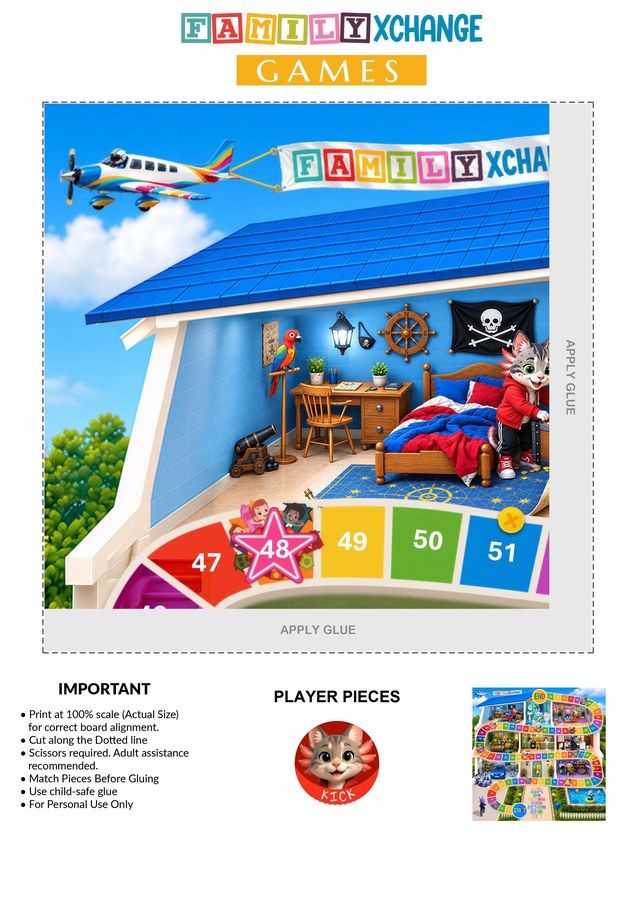
A professionally made board is thicker, folds flat, survives being sat on and looks like something you would leave out on a shelf. It is sold on its own — buy it when you want it, as a gift or at Christmas, not as the price of entry.
Two worlds
Same rules, same app, same dice — a completely different table. The Family Xchange board is the one you can play now; Jungle Beat 2 is still being finalised and we expect it in 2027. When it lands, a family who has both will play either without changing anything — the app knows which board is out.
A cut-away family home — up the driveway, through the garage and the laundry, across the kitchen and the lounge, into the bedrooms. Eleven rooms, twelve characters, and everywhere a sock might go missing.
A prehistoric jungle of rock formations, a river, cave mouths and a volcano — built with the team behind the Jungle Beat animated series and played by its own cast.
Getting started
The full game, both halves of the deck, no limits. Long enough for two or three proper family evenings, which is what it takes to know.
Ten challenges that keep coming round, on a real board, for as long as you like. Small, not crippled — a genuine evening, there are simply ten of them.
The virtual board, the print-at-home board and the whole growing deck. Monthly or annually, cancel whenever you want.
Family Xchange and Jungle Beat 2 will be subscribed to separately, so a family can have one without the other. Jungle Beat 2 is not out yet — everything on this page you can play today is the Family Xchange board. Pricing is announced at launch.
Common questions
No. A subscription includes the virtual board and a board you print at home, so you can be playing the day you sign up. A printed board is a better object to own, not the way in — and if you buy one it ships with a subscription period inside the lid so it works the evening it is opened.
Yes — the virtual board is the whole game on screen. Most families end up printing the paper board anyway, because a board on the table is what gets everyone to sit down.
They get different cards. The app serves each player by age band — 3–6, 7–11 and 12+ — so the same square asks a five-year-old to hop like a frog and a fifteen-year-old what they would do if a friend posted something unkind. Nobody this young is ever sent backwards, either.
Then they never appear. Tier 3 is off by default, topic by topic and child by child, and only a parent can switch any of it on. The game is complete without it.
A family evening rather than a quick round — the conversations are the slow part, and that is the point. Co-op Bedtime Escape has a clock on it if you need the end to arrive by a particular time.
Activate it once with the serial from the card in the box — ten characters, letters and numbers — and set up your family. Takes about two minutes, after which everyone can play from their own device. Sign in or activate →
Read the full tour of both boards, or get in the queue for a printed one.